*On the trail of Ridley Scott’s ‘Gladiator’ – a visit to the Mušov Roman legionary camp: 2 km to 8 km*
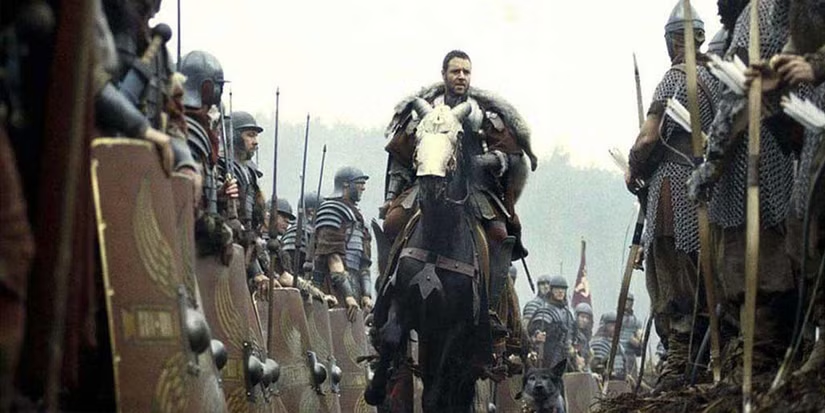
- The opening scenes of Ridley Scott’s Oscar winning film ‘Gladiator’ are considered some of the most epic battle scenes ever filmed. They are (perhaps somewhat surprisingly) historically quite accurate. What is little known is that this epic battle was probably fought somewhere in the Czech lands and that the main operating base for the Roman legions was almost certainly located in South Moravia.
- Over a period of fifteen years, towards the end of the second century AD, the Roman Emperor Marcus Aurelius and his son Commodus fought a series of campaigns against the Germanic tribes north the Danube river. The campaigns are collectively known as the Marcomannic Wars, named after the best known of the tribes, the Marcomanni, who controlled Bohemia and South Moravia at that time.
- The true extent of the Roman presence in Moravia in the second century has only recently been revealed by archaeological studies. Numerous temporary ‘marching camps’ have now been identified, stretching as far north as Olomouc. The largest Roman site so far discovered in Moravia occupies a low hill just to the north of the large Věstonice reservoir, which was created in the 1970’s by damming the Dyje river. At that time, the medieval village of Mušov was abandoned and flooded. The archaeological site has been named after the disappeared village.
- The Mušov camp was clearly not designed to be temporary and may well have been the intended military centre of a planned new Marcomannic Roman province, which would have encompassed much of Moravia and possibly Bohemia. Buildings so far uncovered are bathhouses and a military hospital. The site is large enough to accommodate two full legions. A museum was opened in 2020 just below the hill (somewhat incongruously right next to Aqualand Moravia – the largest waterpark in the country).
- Sadly (at least for Roman enthusiasts), the Province was never established. Bohemia and Moravia remained for evermore outside the Roman Empire. After the final major battle in the Marcomannic Wars and the death of Marcus Aurelius – both occurring in 180 AD – the new Emperor Commodus declined to pursue the campaign (reportedly preferring an easier life back in Rome). He withdrew all Roman troops from Moravia. This was against the advice of the leading general in the campaign, Tiberius Claudius Pompeianus, who was married at the time to Marcus Aurelius’ daughter, Lucilla.
- Pompeianus appears to have been the inspiration for Ridley Scott’s ‘Maximus’ character (played by Russell Crowe in the film) and there are even historical indications that Marcus Aurelius intended Pompeianus to succeed him as Emperor (he declined, apparently). This appears to have been one of those ‘what if’ moments in history. Had Russell Crowe’s character actually become ‘Caesar’ in 180AD, perhaps the course of Central European history would have turned out differently. At the very least, we might have hoped to see the towering arches of a Roman amphitheater in place of the plastic slides of Aqualand!
- Visitors to Mušov today will not find any visible ruins – all the foundations of the Roman era buildings are still covered in heathland (and probably large sections of Aqualand). However, there is a well done educational trail (with Cz/En/De language info boards) that starts on the hill top and then leads along the edge of the reservoir as far as the village of Pasohlávky. The trail starts by discussing the Roman camp and then extends to cover features of nearby Germanic settlements in the same period.
- It is an 8 km round trip, from the camp to Pasohlávky and back to the car park/bus stop located below the camp. The walk around the camp itself (including a visit to the museum) is no more than 2 km (mostly on easy grassy footpaths). However, it is worth doing the full trail (which mostly follows a bike path), not least because there are nice views over the reservoir from close to the village, where the excellent Café Zastávka (map point 6) is waiting to provide refreshments.
- Note: for a longer walk there is an option to continue around the reservoir for a circuit of various lengths. These walks are described separately, here.
Note: click ‘Show on Mapy.com’ to go to a full screen version of the route directly on the mapy.com site. This can be used for on line navigation, saved or exported as a GPX file.
Directions
- Starting from the cark park or bus stop next to Aqualand, head initially up the side road away from the water park to reach the camp center in 700m
- The museum is along the main road towards the aqualand entrance
- To continue on the the educational trail follow the cycle path as far as Pasohlávky, where a bus can be caught back to the start point (or return along the cycle path)
- The educational trail is not marked with trail markers, so the exact route is best followed using the mapy.com phone application or a paper map